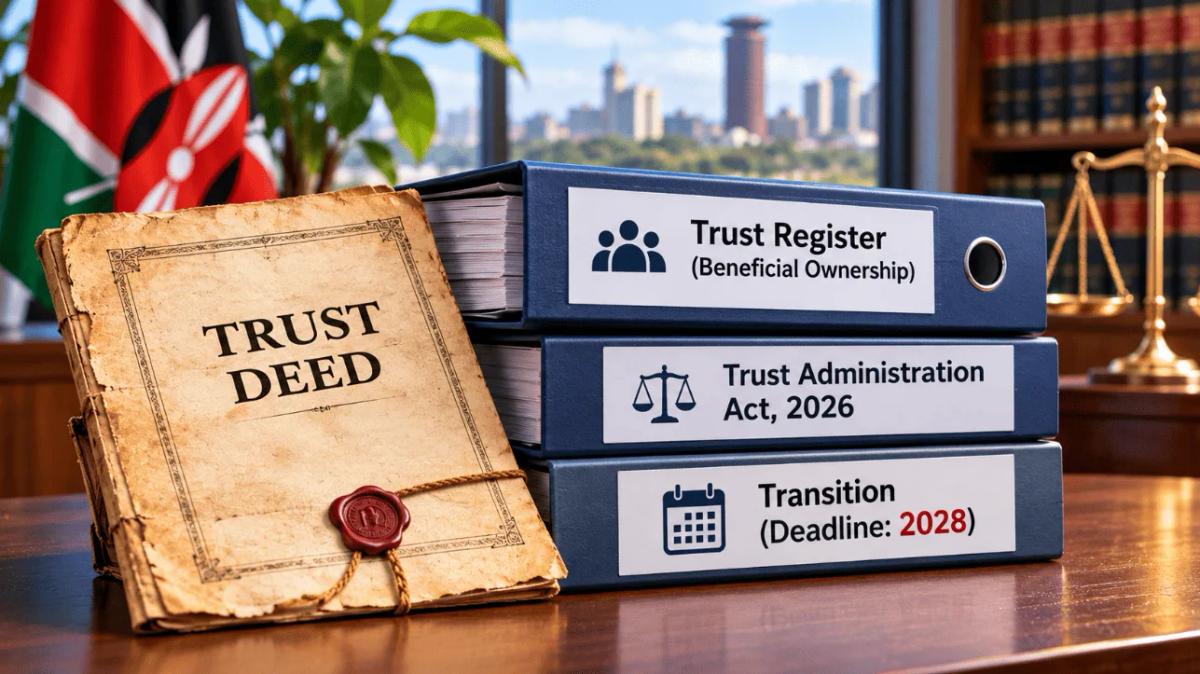
The old trust under the new law: What existing Kenyan trusts must do before the deadline

12 November 2026By Peter Maina
In brief
- Every trust formed under the repealed Trustee Act or Trustees (Perpetual Succession) Act transitioned automatically into the Trust Administration Act, 2026 when it commenced on 25 September 2026. Nothing lapsed and nobody’s rights were lost, but the trust now lives under a new regime with a compliance clock running.
- Full compliance is required within twenty-four months of commencement, that is by 25 September 2028 unless the Registrar sets a different period, and the standing obligations begin before then, a register of beneficial owners kept and lodged, changes notified within twenty-one days, records kept for seven years and an annual return filed each year.
- The Registrar of Trusts has teeth the old law never had, powers to issue directives, demand information and disqualify trustees for up to three years, so the sensible trusteeship treats the transition as a project with a file, not a letter to answer when it arrives.
Full Article
Kenya has thousands of trusts formed under laws that no longer exist, family trusts and charitable foundations incorporated under the Trustees (Perpetual Succession) Act, settlements governed by the Trustee Act of 1929, and deeds lodged under the Registration of Documents Act because nothing better was available. On 25 September 2026 all of them acquired a new statute, because the Trust Administration Act, 2026 [link] repealed both old Acts and gathered every written trust under one Registrar of Trusts at the Business Registration Service. For trustees, the reassuring half of the story is continuity, since existing trusts transitioned automatically and everything done under the old law remains effective. The demanding half is that transition is not compliance, and the new Act expects things the old ones never asked for, on a timetable that has already started. This article sets out what the new law requires of trusts that predate it, who within the trust is responsible, and how a careful trusteeship gets ahead of a Registrar whose powers are considerably sharper than those of the office it replaced. It is written for trustees of family and charitable trusts, the institutions that serve as corporate trustees, and the families whose property sits in structures their founders set up decades ago.
One law where there were three
The old landscape was a patchwork. The Trustee Act supplied Victorian-era administration rules, the Trustees (Perpetual Succession) Act allowed trustees to incorporate and hold property as a body with perpetual succession, and trusts that merely wanted a public record lodged their deeds under the Registration of Documents Act. The 2026 Act replaces the first two and deems trusts registered under the third to be trusts under the new law, so there is now a single statute, a single Registrar and a single register, and the distinctions that matter are the new ones. A trust is registered, which gives it a unique identification number and enforceability, or incorporated, which preserves and continues the corporate personality the old certificate of incorporation conferred, and the trusts most at risk are the informal ones, written deeds that were never registered anywhere, because under the new Act an unregistered, unincorporated written trust is unenforceable, subject only to the court’s discretion on petition. Trustees of such trusts should treat regularisation as urgent rather than optional, and our article on the family trust under the Trust Administration Act, 2026 explains the registration architecture they are regularising into.
What transition actually requires
The Act gives existing trusts twenty-four months from commencement to achieve full compliance, which runs to 25 September 2028 unless the Registrar prescribes a different period, and the word full deserves attention, because compliance is a bundle rather than a form. The trust’s particulars must be brought onto the new register. The governing deed must be reviewed against the Act’s requirements, since provisions that were lawful under a repealed statute may now need amendment, and deeds silent on matters the new law regulates, trustee succession, record keeping, beneficiary information, are better amended deliberately than argued about later. The beneficial ownership position must be established and documented, which for older trusts is the heaviest lift, discussed below. And the trust’s practical administration, minutes, accounts, distributions, must rise to a standard the Registrar can inspect, because the new office does not merely keep records, it supervises. None of this requires panic, and a trust with its papers in order will pass through transition in weeks. What it punishes is the trust nobody has administered for years, whose trustees have died or dispersed, whose deed is a photocopy and whose assets were never formally vested, and for those the twenty-four months is not generous, it is barely enough.
The beneficial ownership register
The centre of the new compliance is transparency about people. Every trust must keep a register of its beneficial owners, lodge a copy with the Registrar, notify changes within twenty-one days and preserve the records for at least seven years after a person ceases to be a beneficial owner, and the draft regulations now in public participation would have the register carry full names, identity numbers, nationalities and dates of becoming or ceasing for the settlors, trustees, enforcers and beneficiaries alike. The information is not for public display, but it is accessible to the Registrar, government and anti-money-laundering authorities, and financial institutions conducting due diligence, which is precisely the point, since the regime exists to end the era of the trust as an unexaminable box. Companies have lived with the equivalent discipline for several years, as our article on the company secretary, the registers and the filings [link] describes, and the practical lesson transfers directly. The register is legal analysis before it is form filling, because deciding who truly stands behind a discretionary trust with a wide beneficiary class takes judgment, and a register built carelessly now invites questions from every bank the trust meets later.
The living obligations, and the Registrar’s teeth
Beyond transition, the Act establishes a rhythm. An annual return goes to the Registrar within thirty days of each anniversary of registration or incorporation. Trust records are kept for at least seven years. Changes in trustees, particulars and beneficial ownership are notified within their windows. And standing behind the rhythm is an office with real powers, to issue directives with which trustees must comply, to require information, and to disqualify a person from acting as a trustee for up to three years, a sanction with professional consequences for the advocates, accountants and institutions who serve as trustees. For corporate trustees the horizon holds more, since the draft regulations propose a licensing regime for companies administering trusts in the course of business, with KES 5 million in minimum capital, a KES 10 million performance bond and KES 50 million in professional indemnity cover as published for comment. Institutions in that business should be planning against those thresholds now and, if the proposed figures would be ruinous or the drafting unclear, saying so in the public participation that closes on 20 November 2026, because regulations are easier to shape than to appeal.
What a careful trusteeship does now
The work organises naturally into a file. Assemble the constitutive documents, the original deed, every supplemental deed, the certificate of incorporation if the trust holds one, and the evidence that the trust’s assets were actually vested in it, titles, share certificates, account mandates, because transition is the natural moment to cure the vesting that never happened. Map the people, trustees living and dead, the mechanism for replacing them, and the beneficial ownership analysis signed off rather than guessed. Diarise the dates, the annual return anniversary, the twenty-one-day change window, and 25 September 2028. Watch the regulations through to gazettement, since the forms, fees and electronic system all arrive with them. And where the trusteeship has drifted, use the transition to renew it properly, because the choice between instruments our article on choosing between a trust and a will [link] describes assumes, quietly, that the trust chosen is actually administered. A trust is a promise maintained across generations, and the new Act, for all its registers and returns, is best understood as Parliament asking trustees to prove the promise is still being kept.
What happens next
The firm is following the draft regulations through public participation to gazettement, and preparing transition files for trusts of every age and condition. For a trusteeship that wants its position reviewed, its register built properly or its deed brought up to the new law, the place to start is a conversation.
Frequently asked questions
Is my old trust still valid under the new law?
Yes. Trusts formed under the repealed Trustee Act or Trustees (Perpetual Succession) Act transitioned automatically into the Trust Administration Act, 2026, and everything lawfully done under the old law remains effective. What changes is the compliance the trust now owes, with full compliance required within twenty-four months of 25 September 2026.
What is the deadline for existing trusts to comply?
Twenty-four months from the Act’s commencement, which runs to 25 September 2028 unless the Registrar prescribes a different period. The standing obligations, the beneficial ownership register, change notifications and annual returns, apply ahead of that date.
What is a beneficial ownership register for a trust?
A record of the natural persons who stand behind the trust, the settlors, trustees, enforcers and beneficiaries, with their identifying particulars, kept by the trust and lodged with the Registrar, updated within twenty-one days of any change and preserved for seven years after a person ceases to be a beneficial owner. It is accessible to the Registrar, regulators and financial institutions conducting due diligence.
Do charitable trusts and foundations have to comply too?
Yes. The Act covers charitable and non-charitable purpose trusts as well as family trusts, and charitable trusts incorporated under the old law transition on the same basis. Exemption applications under the Act are a separate question from transition, which applies regardless.
What happens if the trustees do nothing?
The trust risks arriving at the deadline out of compliance before a Registrar empowered to issue directives, demand information and disqualify trustees for up to three years, and an unregistered written trust is unenforceable. Banks and counterparties are already asking for the new particulars, so in practice non-compliance surfaces at the next transaction rather than at the deadline.
Peter Maina is a Partner of Peter Maina & Company Advocates. This article states the law as at 12 November 2026. It is general information, not legal advice. To review a trust’s transition position, build its beneficial ownership register or bring its deed up to the new law, reach out on e-mail peter@pmlaw.co.ke or WhatsApp +254 714 644 080.

Peter Maina
Peter Maina is an advocate of the High Court of Kenya and the founder of Peter Maina & Co Advocates, advising on Corporate and Commercial Law, Employment and Labour, Real Estate and Land, Banking and Finance, Capital Markets, Regulatory Compliance and Fintech, Corporate Governance, Private Wealth, Trusts & Estate Planning, and Dispute Resolution.
View Full Profile →Need Legal Assistance?
Whether you're dealing with corporate law, commercial disputes, or need professional legal advice, Peter Maina & Co Advocates is here to help.
How We Can HelpRelated Insights
View All Insights →
Putting land and family business shares into a trust: The mechanics that make it real
In brief Full Article The commonest failure in Kenyan trust planning is not a bad deed but an unfunded one. The family signs an elegant trust instrument, files it away with a sense of completion, and never carries out the transfers that would give the trust anything to hold, so that at the founder’s death […]

Grants of probate and letters of administration in Kenya: The process, and what it costs
In brief Full Article When someone dies, their property enters a legal pause. Bank accounts freeze, land cannot move and shares cannot be sold, because the law vests a dead person’s free property in no one until the High Court, or a magistrate’s court within its limits, appoints someone to administer it. The appointment is […]

Trust or will? Choosing the right instrument for a Kenyan estate
In brief Full Article The question arrives at our desk in one form or another every week. Should I write a will, or should I set up a trust? It is asked as though the two were rivals, and the comparison industry online treats them that way, usually ending in whichever instrument the writer happens […]