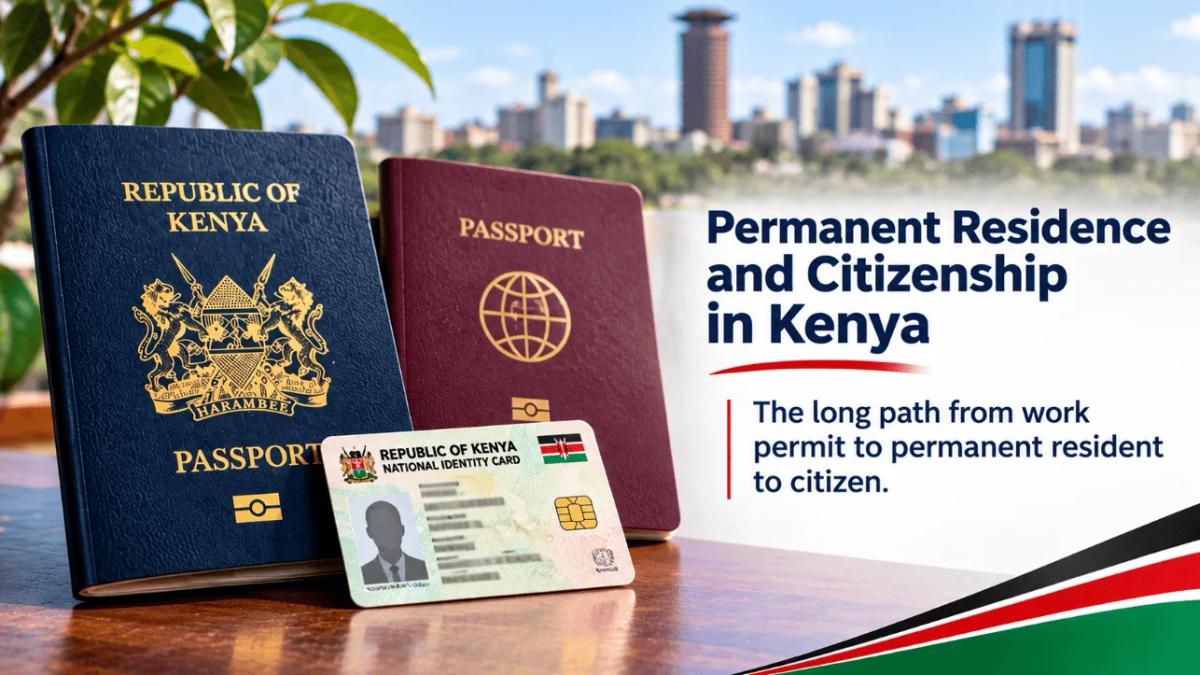
From permit to permanent residence to citizenship: the long path

8 November 2026By Peter Maina
In brief
- A work permit is a subscription, renewed and paid for year after year, and Kenyan law offers two exits. Permanent residence, open among others to permit holders after seven years of lawful and continuous residence and to spouses of Kenyan citizens after three years of marriage, ends the annual cycle. Citizenship, by registration after seven years of marriage or of lawful residence with conditions met, ends the category altogether.
- The path is walked on paper. Continuous lawful residence is proven by the record the applicant kept, unbroken permits, returns filed, no overstays, so the file that succeeds in year seven is built from year one, not reconstructed at the end.
- The destination changes more than convenience. Kenya permits dual citizenship, and a naturalised citizen stands as a citizen everywhere the law looks, including under Article 65 of the Constitution, where the ninety-nine year leasehold ceiling on foreign land ownership falls away.
Full Article
Every article in this run has described a status that expires, the permit renewed annually at KES 500,000, the pass capped at six months, the dependant’s pass standing on someone else’s papers, and for many foreign residents that cycle is simply the price of a Kenyan life, paid indefinitely. It does not have to be. Kenyan law provides a long path out of the renewal economy, through permanent residence and on to citizenship, and the people who reach its end are rarely the ones who waited and hoped, they are the ones who knew the thresholds from the start and kept the file that proves them. This closing article of the run maps the path, who qualifies for permanent residence and what it changes, the routes to citizenship and their tests, and the record keeping that decides both long before any application is filed. It is written for the permit holder in year two who intends to still be here in year ten, and for the mixed Kenyan-foreign family planning the household’s long game.
Permanent residence, and who qualifies
Permanent residence under section 37 of the Kenya Citizenship and Immigration Act opens through four main doors. The spouse of a Kenyan citizen qualifies after three years of marriage. A former citizen of Kenya qualifies as of right in all but name. A child of a Kenyan citizen born outside Kenya qualifies, though as our article on dual citizenship and the order of operations explains, such a child is usually a citizen by birth already and needs nothing at all. And the door this run’s reader will use, the holder of a work permit who has lived in Kenya lawfully and continuously for at least seven years, qualifies on the strength of that residence. What permanent residence gives is the end of the subscription, residence and the right to work without annual classes, fees and renewals, and what it is not is equally worth stating, since it is not citizenship, carries no passport and no vote, and keeps conditions of its own, so it is best understood as the stable middle of the path rather than its end. The application is made to the Directorate with the fee per the current schedule confirmed at filing, and its real cost is the file described below.
Citizenship, and its tests
Citizenship arrives by registration, and the Constitution and the Act set two routes the readers of this run will recognise. The spouse of a Kenyan citizen, married for at least seven years, is entitled to apply, the stronger ground our article on the dependant’s pass promised the mixed family. The lawful resident applies after seven years of residence, with conditions that are tested rather than presumed, continuous physical presence in Kenya for the prescribed period, good character, an understanding of the rights and duties of a citizen, and a working knowledge of Kiswahili or a local language, a requirement applicants underestimate until the interview. Kenya’s side of the dual nationality question is settled and generous, since the Constitution permits dual citizenship, so the new Kenyan need not surrender the old passport as far as Kenya is concerned, though whether the country of origin allows its citizen to naturalise elsewhere is that country’s law, and the disclosure duties our dual citizenship article describes apply from the moment the second citizenship exists. The payoff reaches beyond the passport. A citizen is a citizen everywhere Kenyan law looks, including under Article 65 of the Constitution, so the naturalised Kenyan buys and holds freehold land like any other citizen, and the long path ends exactly where this site’s property articles begin.
The file that carries you
Both applications stand or fall on one phrase, lawful and continuous residence, and the Directorate does not take the phrase on trust. It is proven by the record, every permit and renewal unbroken from the first, endorsements and approvals kept, KRA returns filed for every year, no overstays, no gaps between an expiry and a renewal, and the practical rules of this run now reveal their second purpose. The renewal filed ninety days early protects continuity as well as convenience. The special pass used lawfully instead of the eTA shortcut keeps year three clean for the application in year seven. The employer’s register and diary our Class D article prescribes is also the employee’s evidence. A permit holder who means to walk the path keeps a personal immigration file from the first approval, passports with every stamp, each permit card and approval letter, the tax compliance certificates, the proofs of presence, because the applicant who can hand the Directorate seven tidy years is asking it to confirm a record, while the applicant reconstructing the past is asking it to forgive one.
Walking it deliberately
Set out as a timetable, the path is short to describe. In year one, choose status with the destination in mind, since seven years of lawful residence count whatever the class, but a record scattered across lapsed passes and emergency fixes counts badly. At year three, the spouse of a Kenyan citizen becomes eligible for permanent residence, and the mixed family should decide deliberately whether to take it. Around year five, the long-term permit holder begins assembling the permanent residence file, so that year seven is a filing date rather than a research project. And from year seven, the doors open in sequence, permanent residence on residence grounds, citizenship by registration for the qualifying spouse, and citizenship for the lawful resident who meets the tests, each application prepared once, properly, with the record complete. Families walk it together, the dependants’ unbroken passes becoming their own records, the children of the Kenyan parent already citizens, and the household converging on the same status from different doors. None of it is fast, and that is not a defect, since what the long path offers is the one thing the renewal economy never can, an end.
What happens next
This closes our run on Kenyan work permits and the road beyond them, which begins with what a Kenyan work permit actually costs and runs through the Class G investor permit, hiring under Class D, the special pass, the dependant’s pass and the EAC citizen’s position. For a residence history reviewed against the thresholds, a permanent residence or citizenship application prepared, or a family’s path to permanence planned as one plan, the place to start is a conversation.
Frequently asked questions
Who qualifies for permanent residence in Kenya?
Principally, spouses of Kenyan citizens after three years of marriage, former Kenyan citizens, children of Kenyan citizens born outside Kenya, and work permit holders with at least seven years of lawful and continuous residence. The application is made to the Directorate of Immigration Services and decided on the record of residence.
Does permanent residence end work permit renewals?
Yes. A permanent resident lives and works in Kenya without annual permit classes, fees or renewals. It is not citizenship, carries no passport or vote, and keeps conditions of its own, but it ends the yearly cycle that defines permit life.
How does a foreigner become a Kenyan citizen?
By registration, principally through marriage to a Kenyan citizen for at least seven years, or through seven years of lawful residence combined with continuous presence, good character and a working knowledge of Kiswahili or a local language. The record of lawful residence does most of the work, so it should be kept from the first permit.
Can I keep my original citizenship if I become Kenyan?
Kenya permits dual citizenship, so Kenyan law does not require you to surrender your original nationality, and dual citizens carry disclosure duties under the Act. Whether your country of origin permits its citizens to naturalise elsewhere is a question of that country’s law.
Does becoming a citizen change what land I can own?
Yes, completely. Article 65 of the Constitution limits non-citizens to leasehold tenure of at most ninety-nine years, and a naturalised citizen stands outside that limit, able to buy and hold freehold land like any other Kenyan.
Peter Maina is a Partner of Peter Maina & Company Advocates. This article states the law as at 8 November 2026. It is general information, not legal advice. To review a residence history, prepare a permanent residence or citizenship application or plan a family’s path, reach out on e-mail peter@pmlaw.co.ke or WhatsApp +254 714 644 080.

Peter Maina
Peter Maina is an advocate of the High Court of Kenya and the founder of Peter Maina & Co Advocates, advising on Corporate and Commercial Law, Employment and Labour, Real Estate and Land, Banking and Finance, Capital Markets, Regulatory Compliance and Fintech, Corporate Governance, Private Wealth, Trusts & Estate Planning, and Dispute Resolution.
View Full Profile →Need Legal Assistance?
Whether you're dealing with corporate law, commercial disputes, or need professional legal advice, Peter Maina & Co Advocates is here to help.
How We Can HelpRelated Insights
View All Insights →
What it actually costs a foreign investor to set up in Kenya: the full table
In brief Full Article Every market entry we advise begins with the same request, one table with everything on it, because investors budget from totals and the figures for Kenya are scattered across a registrar, a revenue authority, forty-seven counties, a dozen regulators and an immigration directorate that each publish their own corner. This article […]
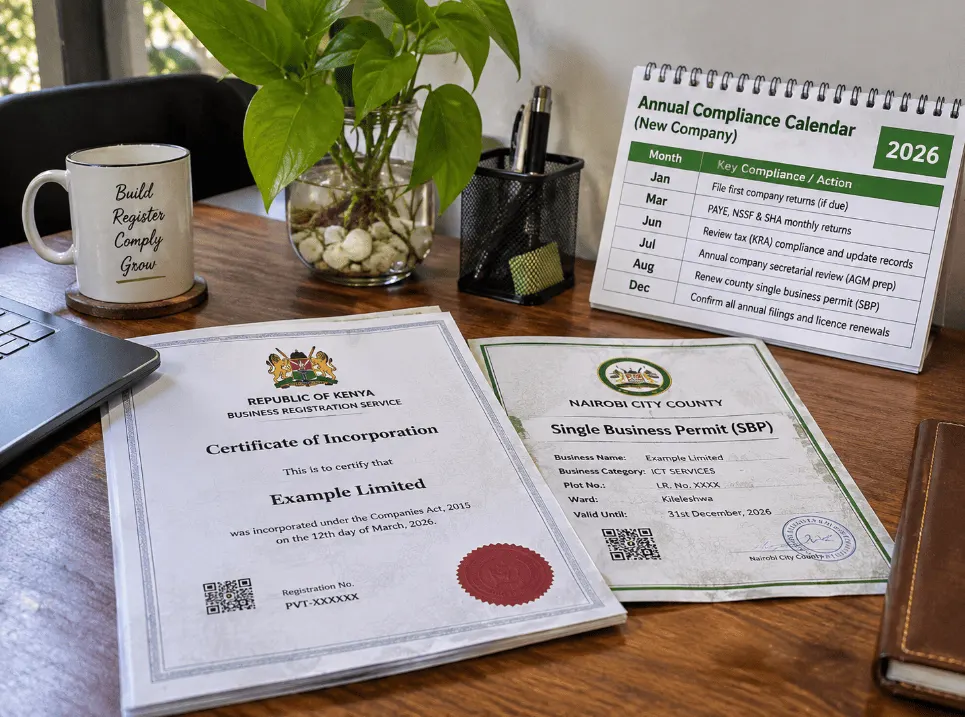
After incorporation: the licences, registrations and the compliance calendar
In brief Full Article The certificate of incorporation arrives by e-mail and feels like the finish line, and for the Registrar it is. For everyone else it is the starting gun. The bank wants more than the certificate, the first customer wants a compliant invoice, the county wants its permit before the doors open, and […]
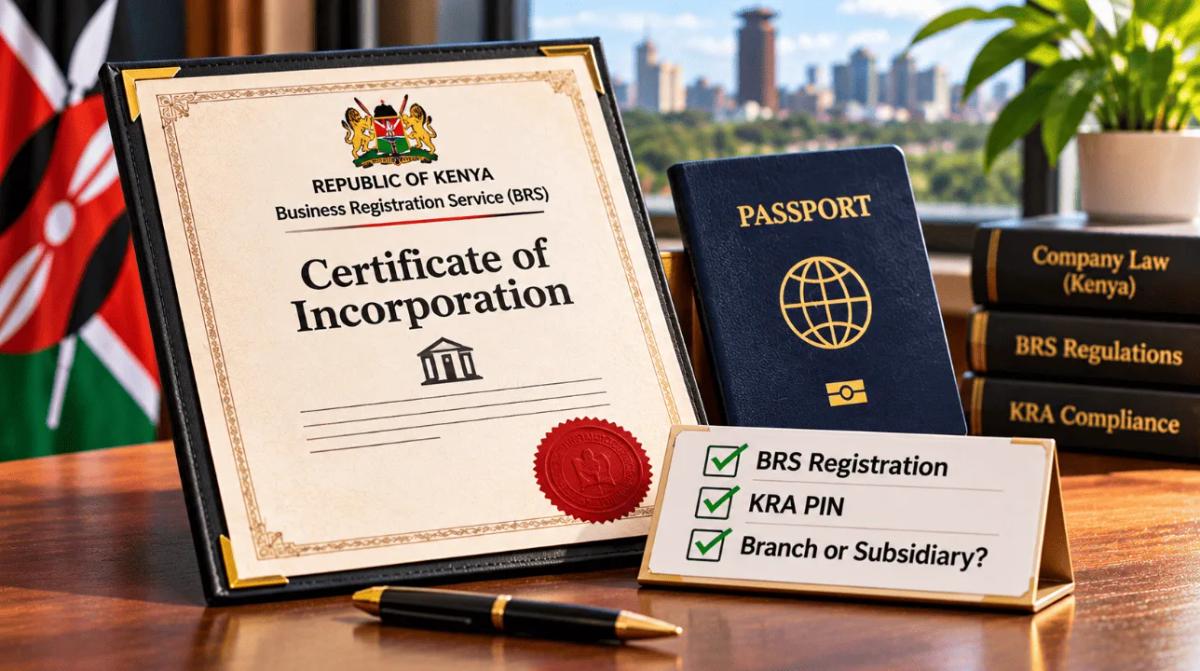
How to register a company in Kenya as a foreigner, and what it costs
In brief Full Article Every foreign investor who approaches us begins with the same two questions, whether they are allowed to own the company and what the setting up will cost, and the honest answers are better than the folklore. Kenyan company law is open, the official fees are modest, and the registration is genuinely […]